
Chancery Court Handles Scott County Probate
Mississippi splits its trial courts into law and equity. Probate falls on the equity side, so the Chancery Court hears it. The Scott County courts page lists estates, guardianships, conservatorships, insurance settlements to minors, and related equity matters under Chancery Court. Wills offered for probate, contested estates, and the appointment of an executor or administrator all move through this court. Adoptions and mental-health commitments are heard here too, though those files are not open like a routine estate.
Scott County sits in the Second Chancery Court District. A chancellor, not a jury, decides these cases. The same district covers nearby counties, and the bench rotates through them. The Chancery Clerk serves as clerk of this court and keeps the estate files once they are filed. For day-to-day record requests, the clerk's office is the place to start. Divorce and child-custody cases run through the same court, and those sit on the marriage and divorce records page.
Scott County Probate Terms Defined
Probate paperwork uses words that rarely show up in daily life. A few short definitions make an estate file much easier to read.
- Testator
- The person who made the will. The will speaks for the testator after death.
- Executor
- The person the will names to carry out its terms, pay debts, and pass property to the heirs.
- Intestate
- Dying without a valid will. State law then sets who inherits the estate.
- Guardianship
- A court arrangement that puts a guardian in charge of a minor or an adult who cannot manage their own care.
- Conservatorship
- A court arrangement that places a person's property and money under a conservator when they cannot handle finances alone.
Scott County Estates and Wills
An estate is opened so debts get paid and property passes to the right heirs. The Chancery Clerk handles estates as part of its Chancery Court duties. When a person dies with a will, the document is offered for probate and filed with the court. The chancellor confirms the will is valid and names the executor it lists. When a person dies without a will, the estate is called intestate, and state law decides who inherits.
An estate file grows as the case moves along. A typical Scott County estate file may hold:
- The petition to open the estate
- The order appointing the administrator or executor
- An inventory of the estate's property
- Accountings of money paid out and taken in
- Notice to creditors and any claims filed against the estate
- The order of distribution and the final closing order
The will itself stays in the file once it is admitted. A closing order ends the case after the estate is fully settled.
Guardianships, Conservatorships, and Minor Settlements
The Chancery Court protects people who cannot manage their own affairs. A guardianship is set up for a minor or for an adult who needs a guardian. A conservatorship covers a person's property and finances when they cannot handle money matters on their own. Both come with court oversight that can last for years, and both produce reports the court reviews.
Scott County's courts page also lists insurance settlements to minors. When a child receives money from a lawsuit or an insurance claim, the chancellor reviews the deal and guards the funds until the child grows up. These cases create reports and accountings much like an estate does. Because they involve a minor, parts of the file may be shielded from open view.
An adult conservatorship can be set up for someone hurt by illness, age, or injury. The court weighs proof before it limits a person's control over their own money. A guardian or conservator answers to the chancellor and files updates on a set schedule. That oversight is what keeps the role honest.
How to Access Scott County Probate Records
No public probate search portal for Scott County was found on official sites. Estate files are reached mostly through the clerk and the courthouse in Forest. The county FAQ routes estate records to the Chancery Clerk's Office, so that office is the main door.
The county's how-do-I guide spells out which office to ask for each kind of record.
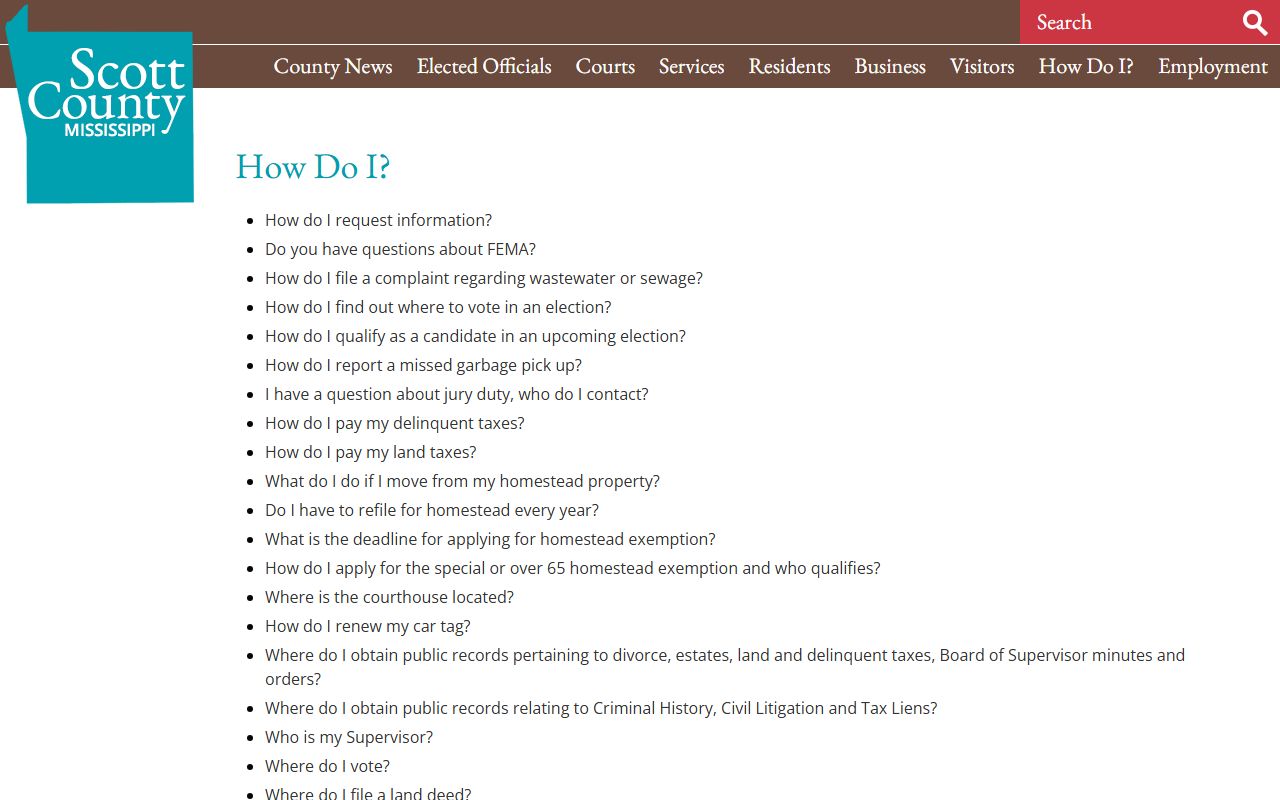
It points estate questions straight to the Chancery Clerk, which saves a wasted trip to the wrong counter. A short route works for most people who need an estate record.
- Confirm the estate or guardianship belongs in Scott County Chancery Court and not in another county.
- Call or visit the Chancery Clerk's office in Forest and give the decedent's name plus any case or estate number you have.
- Ask whether the file is open to the public or holds restricted material that must be redacted.
- Request inspection or copies in person, by mail, or through the county public-records form.
- Pay the copy and labor charges the clerk quotes before the records are released.
Mississippi Electronic Courts, known as MEC, may hold Chancery filings where they have been entered. Scott County Chancery Court started electronic filing back in 2010. Remote viewing through MEC usually needs an account, and the public state pages were blocked during research, so confirm access before relying on it.
Scott County Chancery Court Contact
The Second Chancery Court District runs the chambers that serve Scott County probate. The Honorable Robert M. Logan Jr. serves as chancellor over these matters. Estates, guardianships, and conservatorship petitions are heard by the chancellor on the equity docket.
The Second Chancery Court District site posts the court's mailing address and contact lines.
Use it to confirm the right channel before you send estate or guardianship paperwork.
Second Chancery Court District
PO Box 434
Forest, MS 39074
601-469-2447
Fax: 601-469-3116
judge@2ndchancerycourtdistrictms.org
Call to confirm hours
For copies of an existing estate file, the Chancery Clerk's office is the record keeper. Mailed public-records requests for county records go to the Chancery Clerk at PO Box 630 in Forest. More detail on that office sits on the Chancery Clerk page.
Scott County Probate Filing Fees
Scott County's official pages do not publish a probate filing fee, a small-estate limit, or a will-safekeeping fee. Those amounts must be confirmed with the Chancery Clerk. What the county does publish are its public-records copy charges, which apply when you ask for copies of a file. Mississippi's Public Records Act lets the county charge actual search, copy, and mailing costs.
| Item | Amount |
|---|---|
| Copy of a record, per page | $0.50 |
| Staff labor for search and processing, per hour | $20.00 |
| Non-standard records | Actual material and equipment cost |
| Mailed delivery | Actual postage cost |
| Probate filing fee | Confirm with Chancery Clerk |
Note: The county can charge search time even when no matching record turns up, so ask the clerk for a cost estimate first.
What Scott County Probate Records Show
An open estate file reads like a timeline of how property moved. It can show the will itself, the named heirs, and the value of what the person owned at death. Inventories list real estate, bank accounts, and other assets. Accountings track each dollar that came in and went out during the case.
Guardianship and conservatorship files show who was appointed and what powers the court granted. They also carry the reports a guardian or conservator must file. Some of these papers include medical or capacity details, which the clerk may shield. A creditor notice, a property-sale order, or a final distribution can all appear in the same folder by the time a case closes.
The dates on each filing tell the story of the case. A petition opens it, an order appoints the fiduciary, and a closing order wraps it up. Heirs, named beneficiaries, and the executor or administrator are listed by name in most estate papers. Land tied to an estate may also be traced through the Chancery Clerk's recorded deeds and liens.
Restricted Scott County Probate Records
Not every Chancery file is open. Adoption records are sensitive and generally closed to the public. Access usually needs party status, a statute, or a court order. Mental-health and commitment files carry medical and personal facts, so they are not ordinary public records either.
Guardianship papers that name a minor or hold medical reports may be shielded in part. A sealed estate stays out of public view until a judge lifts the seal. The clerk can redact protected details like Social Security numbers before releasing a copy. When in doubt, ask the office which part of a file is open before you request it.
Note: Adoption, youth, mental-health, and sealed Chancery files are restricted, so an open estate request will not reach them.