
Scott County Arrest Records and Court Charges
A Scott County arrest record is the account of a person being taken into custody. It names the arresting agency, the date, the place, and the booking that follows at the jail. Most arrests in the county are made by the Scott County Sheriff's Department, and others come from the Mississippi Highway Patrol or a city police force. The arrest record shows what an officer alleged at the scene. It does not, on its own, decide what the court will pursue.
The court charge record begins later. After booking, a prosecutor screens the case and files the formal charges with the court. Those charges, not the raw arrest, become the matter the court tracks. The two records sit on different sides of the same event. The arrest and booking detail lives with the sheriff and the jail, so the jail roster and booking data are covered on the Scott County inmate records page. The charges the prosecutor files are followed through the court case itself.
Both files matter when you trace court charges after arrest. One tells you who was held and why an officer acted. The other tells you what the state chose to prove. The full case file, with pleas, hearings, and the final outcome, is laid out on the Scott County criminal court records page.
The Arrest and Booking Side in Scott County
The arrest side starts with the agency that makes the stop. The Scott County Sheriff's Department patrols 610 square miles and runs the county jail, where most local arrestees are booked. Sheriff Michael W. "Mike" Lee leads the office, and its main number handles custody and jail questions. The department's public site is the best first stop for agency contact and booking information.
The sheriff's homepage links the jail, forms, and crime-tip tools that sit next to the arrest process. You can review it at the Scott County Sheriff's Department site.

That homepage points to the jail and roster resources that hold the booking side of Scott County arrest records. Once a person is booked, felony cases head to Justice Court for an initial appearance, and the charge side of the record opens from there.
Scott County Sheriff's Department
531 Airport Road
Forest, MS 39074
Phone: 601-469-1511
Call to confirm hours
How to Find Scott County Arrest Records and Charges
Charges and charge status show up in the court case index, not in a public mugshot board. Mississippi Electronic Courts, known as MEC, is the state e-filing and case system for trial courts. Remote viewing of MEC is account or subscription based, and the exact search fields must be confirmed on the live portal. When the online route does not resolve a request, the clerk who holds the record is the reliable fallback.
- Decide which court holds the charge. Felony matters move through Circuit Court District 8, while many tickets, DUI cases, and initial felony appearances begin in Justice Court.
- Open the Mississippi Electronic Courts portal and sign in, or set up the account or subscription that remote viewing requires.
- Search by the defendant's name or by the case number if you have it.
- Open the case and read the charge list, then check each charge for its code, severity level, and current status.
If the case is not online or the record is older, contact the Circuit Clerk for Circuit Court charges or the Justice Court clerk for lower-court matters. The county routes criminal-history record requests to the Circuit Clerk. As a last resort, a written public-records request reaches non-exempt records that no portal shows.
Who Files Charges After a Scott County Arrest
An officer can allege a crime, but the District Attorney decides the charges that the court will pursue. Scott County sits in Mississippi Circuit Court District 8, which also covers Leake, Neshoba, and Newton counties. District Attorney Steven Kilgore leads prosecution for the district. The DA's office screens cases, files or amends charges, and presents serious felony matters to the grand jury.
The path from arrest to charge has a clear local shape. Felony cases first reach Justice Court for an initial appearance and the filing of the affidavit. Justice Court judges hold sessions at the jail three times each week, which protects the right to an appearance within three days of arrest. From there a felony can move to the grand jury and on to Circuit Court District 8 for prosecution. Lower-level matters can resolve in Justice Court itself.
District Attorney, Circuit Court District 8
Steven Kilgore, District Attorney
Serves Leake, Neshoba, Newton, and Scott counties
Phone: 601-656-1991
Call to confirm hours
Charging Documents in Scott County: Complaint, Information, and Indictment
The charge record opens when the state files a charging document. The kind of document depends on the level of the offense and the stage of the case. A minor charge can start with a sworn complaint or affidavit. A felony often needs a grand jury indictment before it can go forward in Circuit Court. Each document names the accused and lists the specific charges.
| Document | What It Is | Filed By | Common For |
|---|---|---|---|
| Complaint / Affidavit | A sworn statement that accuses a person of an offense and starts the case in a lower court. | Officer or prosecutor | Misdemeanors and initial filings |
| Information | A formal charge filed by the prosecutor without a grand jury vote. | District Attorney | Some felonies and waived cases |
| Indictment | A formal charge returned by a grand jury that finds probable cause to proceed. | Grand jury | Serious felonies in Circuit Court |
Reporting a Minor Incident to the Scott County Sheriff
Not every incident needs an officer at the door. The Scott County Sheriff's Department offers an online self-reporting form for minor matters. The incident must have happened in Scott County, and the report stays unofficial until a deputy reviews it. The form sets limits on what you can attach, and it is meant for low-level events, not for emergencies.
The full rules and the list of reportable incident types appear on the sheriff's self-reporting form instructions page.
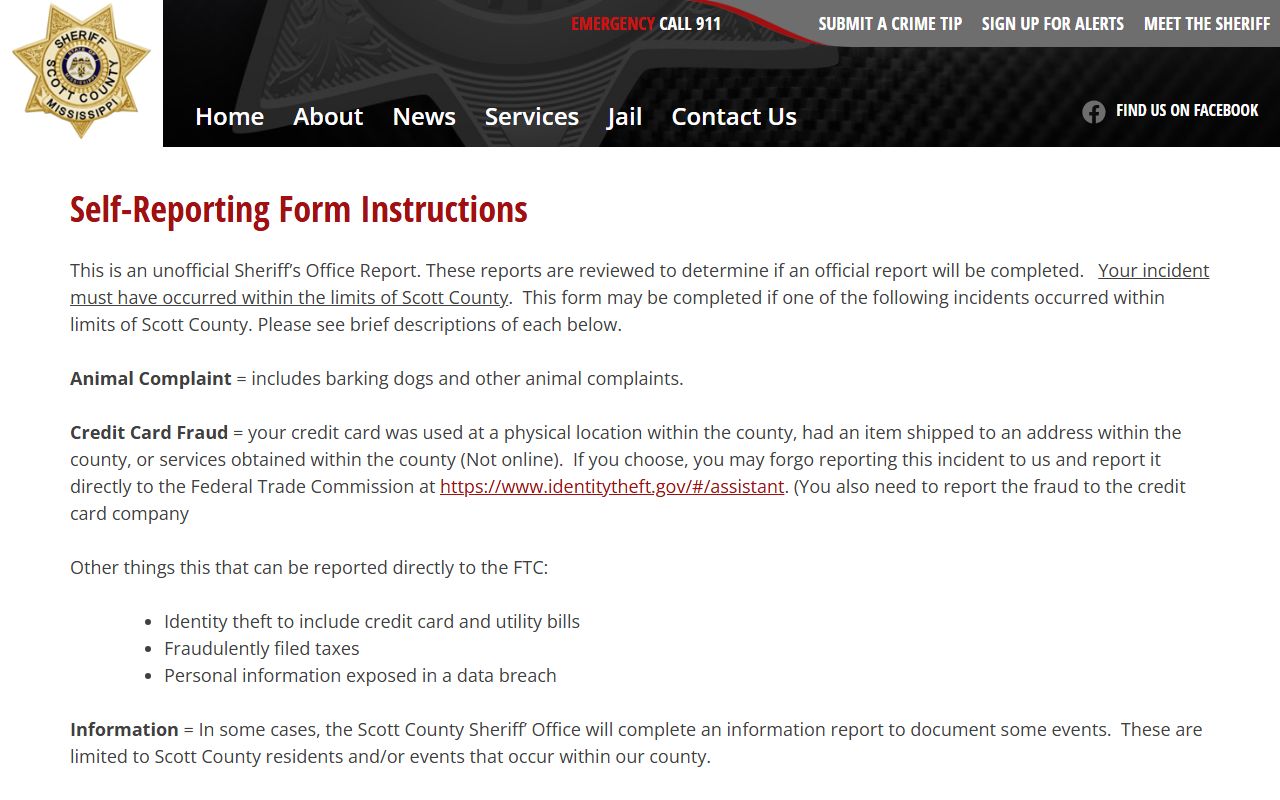
A self-report is not a charge. It can become part of an arrest record only if a deputy reviews it and an officer acts, and only then can a prosecutor weigh charges. For a true emergency, call 911 rather than filing online.
Charge Status in Scott County Court Records
Charges rarely stay frozen. As a case moves, a charge can be amended, reduced, dropped, or dismissed. The status field in a court record tells you where a charge stands right now. Reading it correctly keeps you from treating an old accusation as a final result. The terms below appear often in Mississippi case records.
| Status | What It Means |
|---|---|
| Filed | The charge has been entered with the court and the case is active. |
| Amended | The wording or count of the charge has been changed by the prosecutor. |
| Reduced | The charge has been lowered to a less serious offense, such as a felony dropped to a misdemeanor. |
| Dismissed | The charge has been ended by the court and is no longer pursued. |
| Nolle Prosequi | The prosecutor has chosen not to pursue the charge, formally setting it aside. |
| Bound Over | The case has been sent up from a lower court to the grand jury or Circuit Court. |
Note: A dismissed or nolle prosequi charge may later be removed from public view through expunction, so an older record will not always match the current file.
Charge Codes and Severity Levels in Mississippi
Each charge is tied to a Mississippi statute, and that statute sets its severity. A charge record lists the code so the offense can be identified without guesswork. The three broad levels run from minor to serious. One arrest can produce several separate charges, and each charge carries its own code and level.
- Felony: the most serious level, handled in Circuit Court and carrying the longest possible penalties.
- Misdemeanor: a lower-level offense often resolved in Justice Court or Municipal Court.
- Ordinance violation: a breach of a local county rule, such as the recreational vehicle and junkyard ordinances brought in Scott County Justice Court.
The code matters because two charges that sound alike can sit at different levels. A reduced charge keeps the same general name but moves to a lighter statute and a lighter penalty. When a record shows a code you do not recognize, the clerk for that court can point you to the statute behind it.
Charges vs. Convictions in Scott County
A charge is an accusation. A conviction is a finding of guilt. The two are not the same, and a Scott County arrest or charge record can show a charge that never led to a conviction. The bar a charge must clear is far lower than the bar for a conviction, which is one reason many charges are later dropped, reduced, or dismissed.
| Charge | Conviction | |
|---|---|---|
| Stage | Accusation at filing | Verdict or guilty plea |
| Burden of Proof | Probable cause | Beyond a reasonable doubt |
| Who Decides | Prosecutor or grand jury | Judge or jury |
| Public Record | Yes | Yes |
Reading a record with this split in mind keeps the facts straight. A filed charge tells you what the state alleged. Only a conviction tells you the case was proven. The plea, verdict, and sentence that turn a charge into a conviction are part of the full criminal case file.
Statewide Charge and Criminal History Lookups
There is no confirmed statewide free database that lets the public pull every Scott County charge in one place. Criminal history is reached through official channels, not through commercial data brokers. The Scott County FAQ routes criminal-history record requests to the Circuit Clerk, who holds Circuit Court criminal files, indictments, and judgments. Justice Court holds its own lower-court charge records.
When a record is not online, the county public-records request is the dependable fallback. The county charges $0.50 per page and $20 per hour for labor, and it aims to produce records within 7 business days or to explain the delay, with production generally within 14 business days. Mark the request clearly as a "Public Records Request" and send it to the Chancery Clerk at PO Box 630, Forest, MS 39074. The right to inspect public records sits in the Mississippi Public Records Act, set out by the Mississippi Ethics Commission.
Restricted Charge Records in Scott County
Not every charge stays open to the public. Youth Court matters are confidential, so a juvenile's charges are not part of an ordinary records search. Sealed and expunged charges drop out of the public file as well. Expunction can apply to dismissed charges, non-convictions, and some eligible convictions, and once a judge grants it, clerks and agencies remove or restrict the record.
Mississippi handles expunction under Section 99-19-71 of the state code. The official current-code page for that statute was not located during research, so the exact text should be confirmed in the official Mississippi Code before you rely on it. A clerk can explain filing steps but cannot give legal advice or remove a record without a court order.
- Sealed
- The record still exists but is hidden from public view, with limited access kept for the court and law enforcement.
- Expunged
- The record is treated as if the charge never happened, and public access is removed.
- Dismissed or Nolle Prosequi
- The charge was ended or set aside, and such outcomes are often the basis for a later expunction request.
Note: Active investigations and sensitive law-enforcement files can also be withheld, so an open case may show less detail than a closed one.