
Criminal Court Records in Scott County
A criminal court record is the case file a court opens when a person is formally charged with a crime in Scott County. The Circuit Clerk, Rebecca "Becky" Gray, keeps the felony case files. That means the indictments, motions, judgments, and sentencing orders all flow through her office. Once a case opens, every filing and ruling is logged in that file. The record grows as the case moves, and it stays after the case closes. For a closer look at the charges as filed, see the Scott County arrest and charge records. For every type of court file across the county, start with the full court records.
Criminal cases in Scott County do not all begin in one place. Felony matters first reach Justice Court for the initial appearance and the filing of the affidavit. Justice Court judges hold sessions at the jail three times each week, so a person gets a first court appearance within three days of arrest. The case then moves to the District Attorney and the grand jury before a felony indictment lands in Circuit Court District 8. Misdemeanors, traffic citations, and county ordinance cases often stay in Justice Court or in a city Municipal Court.
District 8 covers Leake, Neshoba, Newton, and Scott counties, and its felony cases are prosecuted by District Attorney Steven Kilgore. The bench changed in 2025, when Governor Tate Reeves appointed Christopher M. Posey to the 8th Circuit Court District after Judge Mark Duncan retired.
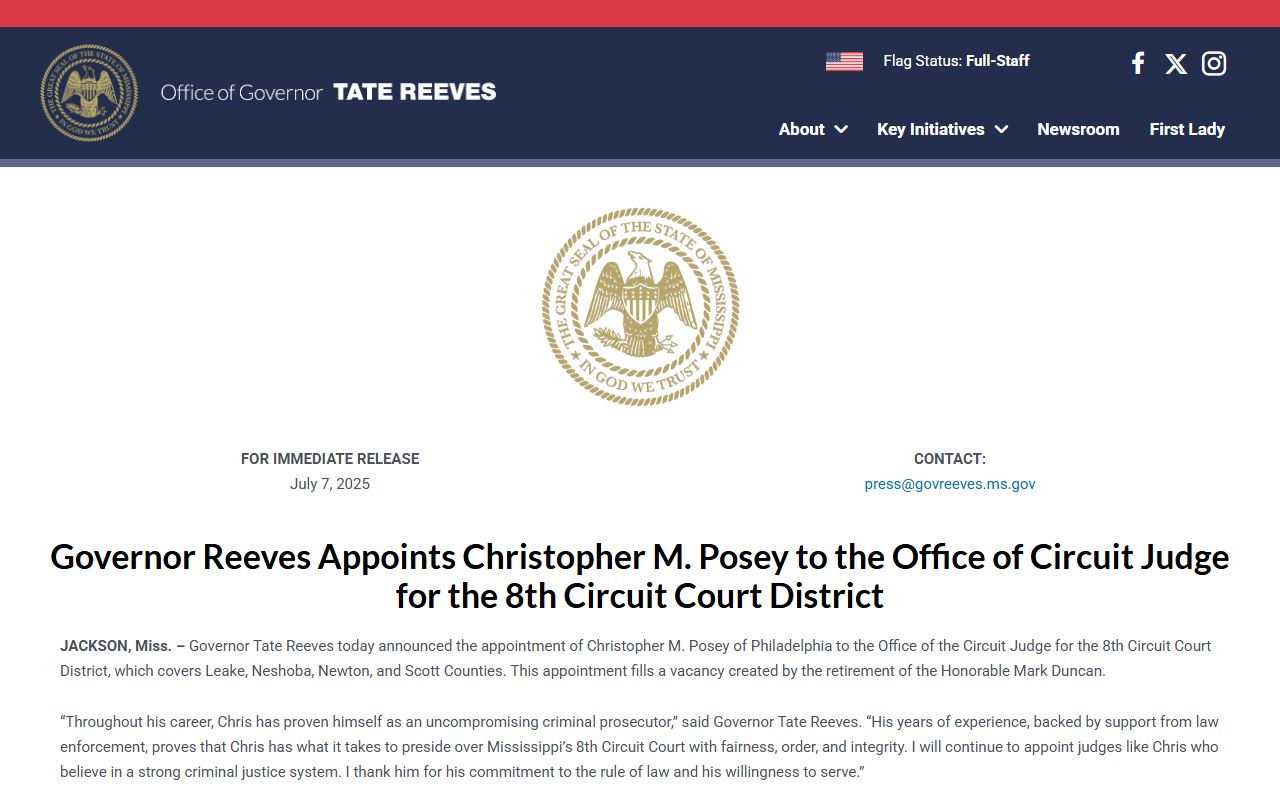
Judge Posey now sits beside Hon. Caleb May, and both names can appear on Scott County criminal court records as a felony file grows. The judge who signs the order is part of the record you read.
How to Search Scott County Criminal Court Records
Scott County criminal case files are managed through Mississippi Electronic Courts, the statewide e-filing and case system for trial courts. Remote viewing of full case documents is account and subscription based, and the official portal sits behind a login. When the online route stalls, the Circuit Clerk's counter at the courthouse in Forest is the free local fallback. The county routes criminal-history requests to the Circuit Clerk's office, so that is where most searches end up.
- Open the Mississippi Electronic Courts portal and check whether remote case viewing is open to your account.
- Search by the defendant's full name or by the case number if you have it.
- Narrow the results by court, case type, and filing date.
- Open the case to read the docket, the charges, and the disposition.
- Request a certified copy from the Circuit Clerk if you need an official record.
State-level criminal history is gathered through the same court system and the Circuit Clerk. Sealed and expunged matters do not appear in any public search. If you cannot reach a file online, the Scott County public-records process and a call to the Circuit Clerk at 601-469-3601 will get you to the record.
Note: Remote document access through Mississippi Electronic Courts is account based, so confirm your viewing rights and the field labels on the live portal before you rely on it.
Stages of a Scott County Criminal Case
A criminal case leaves a trail at every stage, and the record marks each one. The first charge opens the file. Hearings, motions, and the plea or trial fill it in. The final order closes it. Reading the stages in order is the easiest way to follow a Scott County criminal case from start to finish.
Case flow: Charges Filed › Arraignment › Pretrial / Motions › Plea or Trial › Disposition › Sentencing
| Stage | What Happens |
|---|---|
| Arraignment | The defendant hears the formal charge in court and enters a first plea. For felonies in Scott County, this can happen by video court at the jail. |
| Pretrial / Motions | Lawyers file written requests, exchange evidence, and argue points of law. Bond terms and continuances are set during this phase. |
| Plea or Trial | Most cases end in a plea. Others go to a jury in Circuit Court, where guilt must be proven beyond a reasonable doubt. |
| Sentencing | After a guilty plea or a guilty verdict, the judge imposes the punishment and signs a sentencing order that closes the case. |
The judges who sign those orders are public officials, and their swearing-in is part of the record too. The Mississippi Judiciary reported that Circuit Judge Christopher Posey took the ceremonial oath for the 8th Circuit bench in 2025.
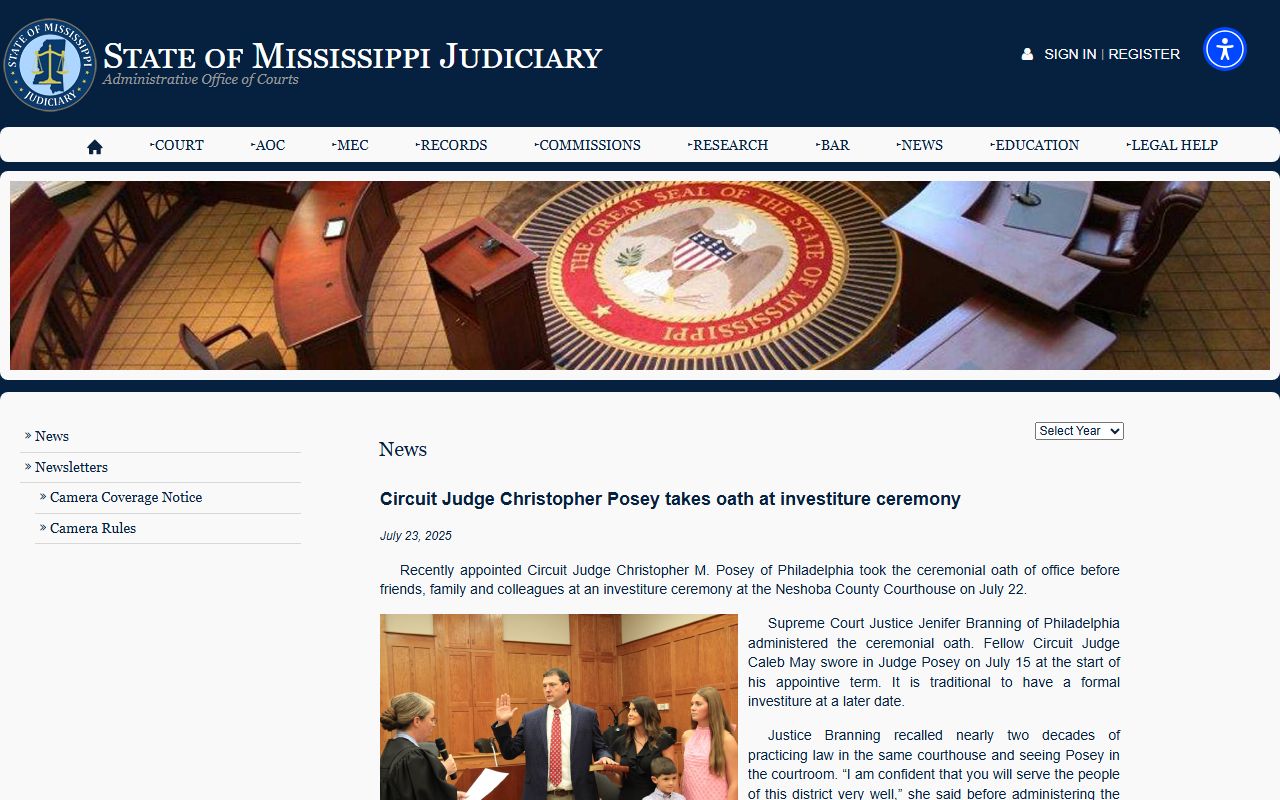
His rulings and orders in felony matters become part of the Scott County criminal court records the Circuit Clerk keeps on file.
What a Scott County Criminal Court Record Shows
Once you open a file, the fields read in a set order. A Scott County criminal court record names the people, the charges, and the outcome. The Circuit Clerk's office receives the lawsuits, indictments, and motions, issues the summonses and subpoenas, and keeps the judgments and executions. Each of those papers maps to a field in the case file.
| Field | What It Shows |
|---|---|
| Case Number | The unique ID the clerk assigns when the case opens. Use it to pull the full file fast. |
| Filing Date | The date the indictment or charge was filed in court, which starts the case clock. |
| Court | The court that holds the case, such as Circuit Court District 8 for felonies. |
| Defendant | The person charged, by full legal name and any aliases on file. |
| Attorneys | The prosecutor and the defense counsel of record, appointed or retained. |
| Charges | Each count as filed, with the statute cited and the severity level, felony or misdemeanor. |
| Plea | The defendant's formal answer to each charge, such as guilty, not guilty, or no contest. |
| Hearing Dates | Scheduled court dates, including arraignment, motion hearings, and trial settings. |
| Disposition | The final outcome of each count, such as dismissed, convicted, or acquitted. |
| Sentence | The punishment after a conviction, including jail or prison time, probation, fines, and conditions. |
Charges vs. Convictions
Being charged is not the same as being convicted. A charge is an accusation, filed because an officer or a grand jury found probable cause. A conviction comes only after a plea of guilty or a verdict that proves guilt beyond a reasonable doubt. A Scott County criminal court record can show a charge that was later dropped, dismissed, or that ended in a not-guilty verdict. Reading the disposition line is the only safe way to tell which one you are looking at.
| Charge | Conviction | |
|---|---|---|
| Stage | Accusation | Verdict or plea |
| Burden of Proof | Probable cause | Beyond reasonable doubt |
| Public Record | Yes | Yes |
Reading Dispositions and Sentences
The disposition line tells you how each count ended. Some words carry weight. "Guilty" and "convicted" mean the charge stuck. "Dismissed" and "nolle prosequi" mean the state dropped the count. "Nolo" or "no contest" means the defendant did not fight the charge but did not admit it. "Acquitted" means a jury found the person not guilty.
The sentence follows the disposition. A Scott County sentence can mix jail or prison time, probation, fines, court costs, and restitution. Suspended time and deferred outcomes appear here too. Look for the signed sentencing order, since that is the document that controls. A short docket note alone is not the order. Case status fields also tell you where things stand:
- Open or pending: the case is active and not yet decided.
- Disposed or closed: a final order has been entered.
- Dismissed: the charge was dropped before a verdict.
- Continued: a hearing or trial was postponed to a later date.
- Appealed: a party asked a higher court to review the case.
Note: The signed sentencing order controls the outcome, so always verify a disposition against the order itself rather than a brief docket entry.
Sealed vs. Expunged Records
Some criminal records leave public view. Sealing hides a record but keeps it for authorized eyes. Expunction goes further and treats the record as if it never existed. Mississippi handles expunction under Section 99-19-71, which covers many non-convictions and a set of qualifying convictions. A clerk cannot seal or erase a record on request. It takes a petition in the court that handled the case and a judge's order.
| Sealed | Expunged | |
|---|---|---|
| Visibility | Hidden from public | Destroyed or treated as never existed |
| Law Enforcement | Limited access | Very limited access |
| Eligibility | Youth Court files; records sealed by court order | Non-convictions and qualifying convictions under § 99-19-71 |
Eligibility for expunction is fact-specific, and a clerk can share filing information but cannot give legal advice. The official current-code text for the expunction statute was not located through a government source during research, so confirm the law in the Mississippi Code before acting on it.
Public Access to Scott County Criminal Court Records
Criminal court files in Mississippi are public records unless a law makes them otherwise. The Mississippi Public Records Act opens government records to any person for inspection. Court case files fall under that rule, so a Scott County felony judgment or sentencing order is generally open. The county sets its fees and timelines in a written policy and asks for requests in writing when a record is not online.
Key Statutes:
Mississippi Code § 25-61-1 - The Public Records Act opens government records to any person unless a specific law exempts them.
Mississippi Code § 25-61-5 - Public bodies must adopt written procedures for handling records requests.
Mississippi Code § 25-61-7 - Agencies may charge actual search, copy, and mailing costs for fulfilling a request.
When the court system does not show the file, the Scott County public-records request form is the universal fallback. The county aims to produce records within seven business days, or to explain the delay, and to deliver within fourteen business days in most cases. Expect charges for labor, copies, and any attorney redaction the record needs.
Background Checks and Scott County Criminal Records
People run a name through criminal records for many reasons. A landlord screening, a hiring check, or simple due diligence all start the same way. A casual online lookup is not the same as a formal background check. Employment and tenant screening fall under the Fair Credit Reporting Act, which sets strict rules on how a report is built and used. For those uses, an official channel or an FCRA-compliant agency is the right path. For a single case, a certified copy from the Circuit Clerk is the gold standard.
Important: This website is a privately run resource and is not an FCRA-regulated consumer reporting agency, so its results may not be used for credit, hiring, housing, or insurance decisions.
Restricted Scott County Criminal Court Records
Not every criminal matter is open to the public. Youth Court records are the clearest example. Scott County Youth Court handles delinquency, children in need of supervision, and abuse or neglect, and those files are confidential by law. A youth-court record can be sealed when the juvenile turns 20 or when the case is set aside or dismissed.
The Mississippi Bar explains the confidentiality and sealing rules that protect young people, in its guide to the rights of juveniles who are arrested.
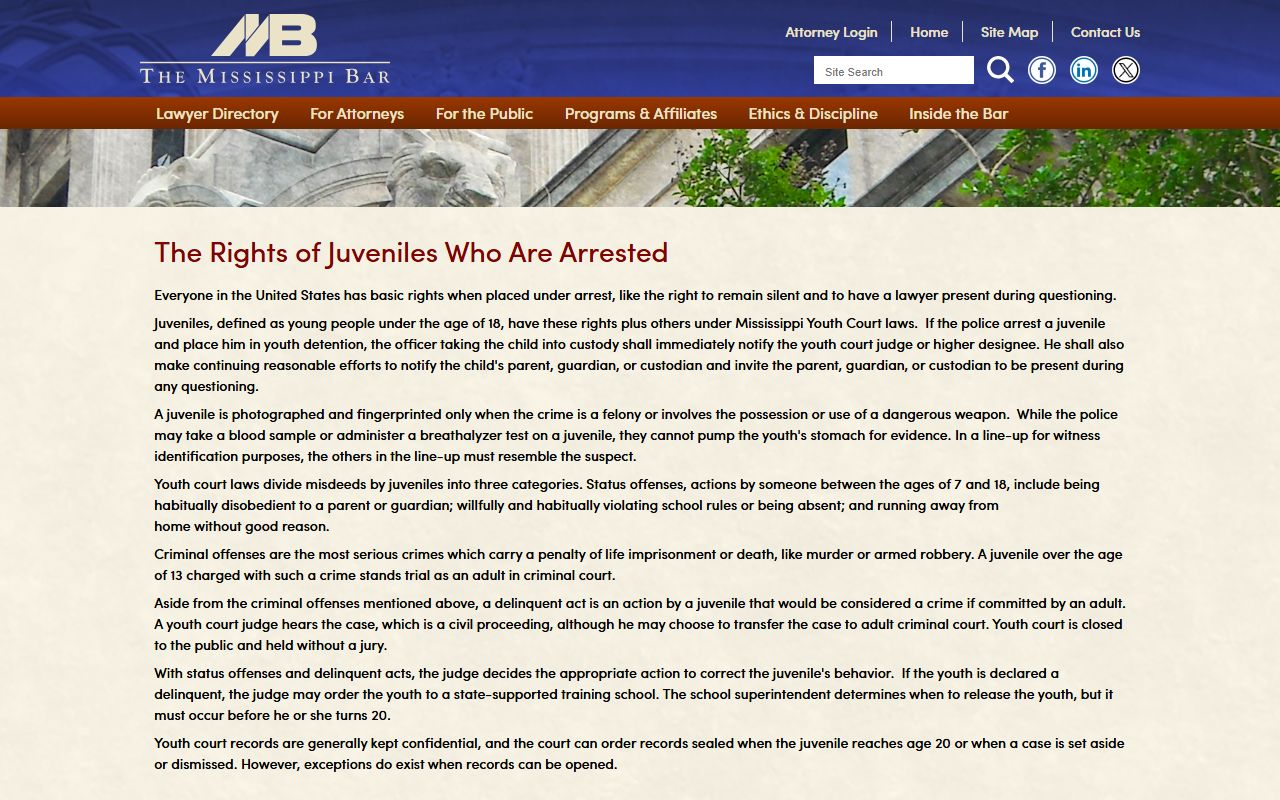
Because of those rules, Scott County criminal court records for minors do not surface in an ordinary case search. Sealed and expunged adult cases also stay out of public view. Mental-health commitments, adoption files, and anything a judge has sealed by order are restricted. Ongoing investigations and some pretrial materials may be held back until a case resolves. Public copies are redacted to hide Social Security numbers, financial account numbers, and protected details about minors.